If you run a plumbing, HVAC, roofing, electrical, landscaping, cleaning, painting, handyman, remodeling, pest control, pressure washing, or other home service business, Nextdoor can be a valuable source of local leads.
But simply creating a Nextdoor Business Page and posting occasionally does not guarantee customers.
The businesses that generate consistent leads from Nextdoor usually do several things well:
- They make their Business Page easy to trust.
- They build legitimate Faves and recommendations.
- They publish useful content for local homeowners.
- They target the neighborhoods they actually serve.
- They respond quickly when homeowners show buying intent.
- They use tools such as Business Posts and Opportunity Alerts strategically.
- They track leads, booked jobs, and revenue instead of focusing only on views.
In this guide, you’ll learn how to get more leads from Nextdoor for your home service business, including what to post, how to build local trust, how to convert attention into inquiries, and how to avoid the mistakes that waste time and money.
Quick answer: The most effective way to get more Nextdoor leads is to combine a complete Business Page, strong local reputation, useful homeowner-focused content, clear calls to action, fast responses, and targeted Nextdoor tools such as Business Posts and Opportunity Alerts.
Why Nextdoor Can Generate Leads for Home Service Businesses
Home services are naturally local.
A homeowner with a leaking pipe usually does not want a plumber from another state. Someone with a damaged roof wants a roofing contractor who serves their neighborhood. A homeowner looking for lawn care wants someone who can actually reach their property.
That geographic connection makes neighborhood-based marketing particularly relevant.
Nextdoor is built around local communities, recommendations, and neighborhood conversations. Its current business platform allows local businesses and home service providers to create Business Pages and use Business Posts to communicate with nearby customers.
More importantly, homeowners often need a service before they know which company to hire.
For example:
Problem:
“My AC stopped working.”
Question:
“Does anyone know a reliable HVAC company around here?”
Decision:
The homeowner looks at recommendations, local businesses, previous experiences, and available providers.
This is where a strong Nextdoor presence can put your company into the consideration set.
Nextdoor leads are often trust-driven
A home service purchase is different from buying an inexpensive product online.
You’re asking a homeowner to let someone into their home and potentially spend hundreds or thousands of dollars.
Trust matters.
That is why your Nextdoor lead-generation strategy should not be built entirely around advertisements.
It should build a path like this:
Visibility → Familiarity → Trust → Inquiry → Estimate → Job → Recommendation → More Leads
The goal is not simply to get seen.
The goal is to become one of the local businesses homeowners feel comfortable contacting.
10 Ways to Get More Leads From Nextdoor
1. Optimize Your Nextdoor Business Page First
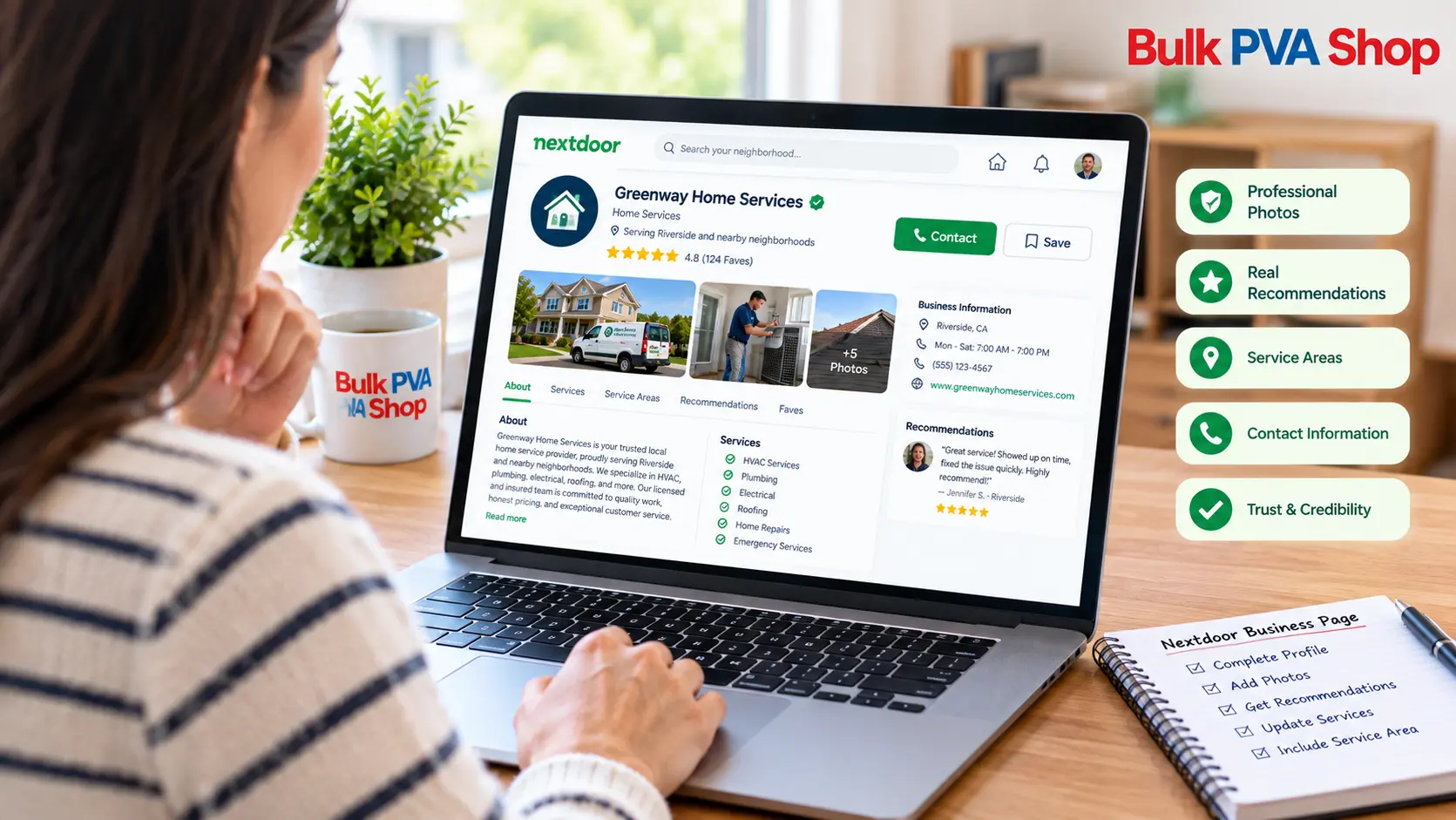
Before trying to generate more traffic, make sure your Business Page can convert that traffic.
Think of your Business Page as your Nextdoor landing page.
When a homeowner discovers your company, they should immediately understand:
- What you do
- Where you work
- What services you offer
- How to contact you
- Why they should trust you
- What other local customers think about your business
Nextdoor’s current Business Page tools are designed to help businesses build local reputation, collect Faves and recommendations, and connect with customers.
Include these elements:
- Accurate business name
- Correct service category
- Professional logo
- High-quality business photos
- Clear description
- Service list
- Service areas
- Business hours
- Phone number
- Website
- Relevant customer recommendations
- Faves from legitimate customers
Write a location-focused description
Avoid a generic description like:
“We are the best HVAC company. Call us today!”
Instead, explain what you do and where you do it.
For example:
Family-owned HVAC company serving homeowners throughout North Dallas. We specialize in AC repair, heating service, seasonal maintenance, and system replacement. Our technicians focus on honest recommendations, clear estimates, and dependable service.
This tells a homeowner three important things:
What: HVAC services
Where: North Dallas
Why: Clear, trustworthy service
That’s much stronger for local conversion.
2. Build More Faves and Recommendations
If you want more Nextdoor leads, don’t overlook your existing customers.
Your happiest customers can become one of your strongest lead-generation assets.
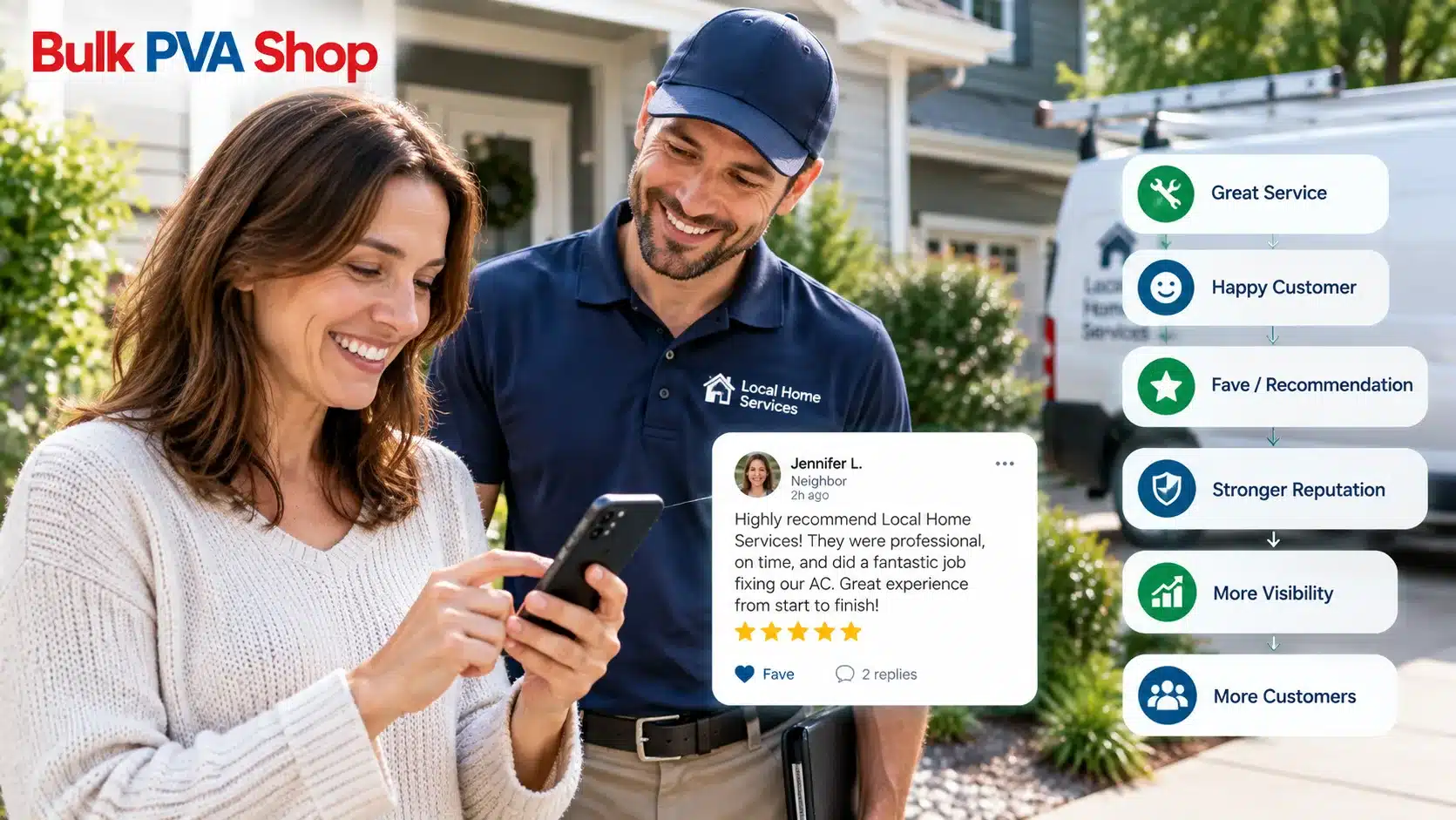
Nextdoor describes a Fave as a recommendation from a verified neighbor who has personally used or chosen a business. Faves help build earned reputation and visibility, and businesses can share their Fave link with customers.
That creates a powerful local marketing cycle:
Great service → Happy customer → Fave/recommendation → Stronger reputation → More visibility → More customers
Ask at the right time
Don’t randomly ask every person for a recommendation.
Ask after a successful customer experience.
For example:
Job completed → customer is satisfied → invoice sent → thank-you message → Fave/recommendation request
You can make the process simple:
“Thanks again for choosing us. We’re glad we could get everything taken care of. If you’ve been happy with our service, we’d really appreciate a Fave or recommendation on Nextdoor.”
Keep it genuine.
Don’t manufacture recommendations, pressure customers, or create fake social proof.
The objective is to turn real customer experiences into visible local trust.
3. Create Business Posts That Solve Homeowner Problems
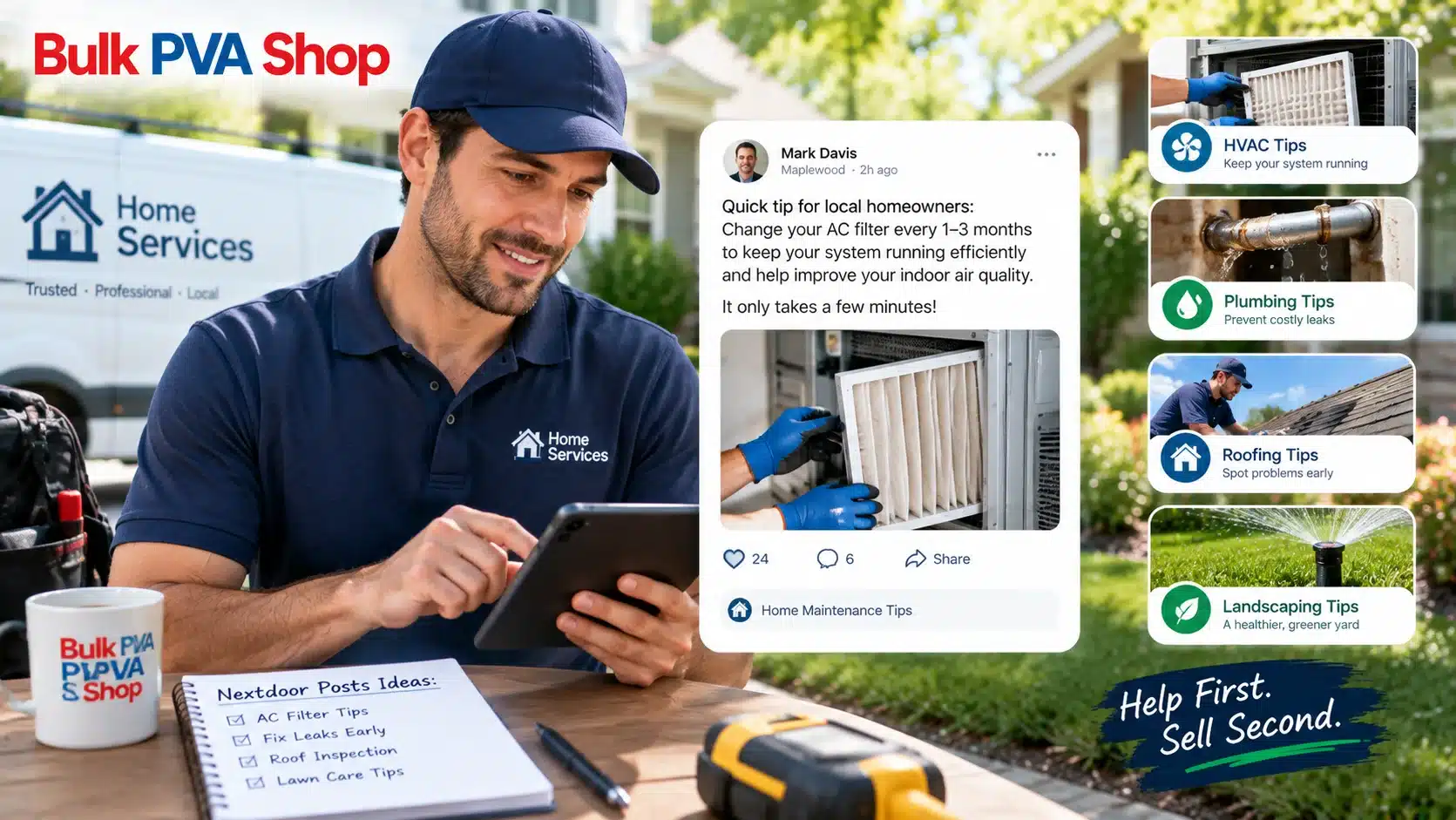
One of the biggest mistakes home service businesses make on Nextdoor is treating every post like an advertisement.
Instead of constantly saying:
“Call us for your plumbing needs!”
teach homeowners something useful.
Nextdoor says Business Posts can help businesses promote their services, connect with the community, and generate new leads. Businesses can also define the audience by adjusting the radius or selecting specific neighborhoods.
Examples for plumbers
- 5 signs your water heater may be failing
- What to do when a pipe starts leaking
- Why your water pressure suddenly dropped
- When a clogged drain needs professional attention
- How homeowners can prevent frozen pipes
Examples for HVAC companies
- 5 signs your AC needs service
- Why one room is hotter than the rest of your house
- How often should you change your HVAC filter?
- Repair vs. replacement: what homeowners should consider
- What to check before the next heat wave
Examples for roofers
- Signs your roof may have storm damage
- When should you schedule a roof inspection?
- How to identify a roof leak
- Common causes of missing shingles
- What homeowners should know after a major storm
Examples for landscapers
- When to fertilize your lawn
- Common lawn problems in your area
- How to prepare your yard for summer
- 5 signs your trees need professional attention
- Before-and-after landscaping projects
The formula is simple:
Help first. Sell second.
4. Make Your Posts Hyperlocal
Generic content can work on social media.
But local service businesses have a major advantage: local relevance.
Don’t just write:
“How to prepare your lawn for summer.”
Make it more geographically relevant:
“3 Lawn Problems Homeowners in [City] Should Watch for This Summer”
Or:
“What Homeowners in [Neighborhood] Should Check Before the Next Heavy Storm”
Or:
“Seeing Brown Spots in Your [City] Lawn? Here’s What May Be Causing Them.”
This approach gives your content a stronger connection to the people you’re actually trying to reach.
Use local signals naturally
Mention:
- City
- Neighborhood
- Service area
- Local weather conditions
- Seasonal issues
- Common housing characteristics
- Local events when genuinely relevant
- Problems frequently encountered in the area
This is also useful for GEO — Generative Engine Optimization because it creates clearer associations between your business, services, geography, and customer problems.
5. Respond Quickly to High-Intent Opportunities
Not every Nextdoor interaction is a lead.
But some posts show extremely strong buying intent.
For example:
“Looking for a plumber who can come today.”
“Can anyone recommend a roofer?”
“Need someone to repair my fence this week.”
“Does anyone know a reliable electrician?”
These are much more valuable than a generic post receiving likes.
Your job is to recognize buying signals and respond appropriately.
A useful response structure
1. Acknowledge the problem.
2. Establish relevance.
3. Explain what you can help with.
4. Give the homeowner an easy next step.
For example:
“We handle plumbing repairs throughout the area and have helped with similar leaks. If you’re still looking for someone, feel free to message our Business Page and we can see what availability looks like.”
Keep the response helpful rather than aggressive.
And remember Nextdoor’s 2026 policy: commercial promotion should come from a Business Page rather than using a personal neighbor account as a business advertising channel.
6. Use Nextdoor Opportunity Alerts
For some home service businesses, Opportunity Alerts can be one of the most direct ways to find potential leads.
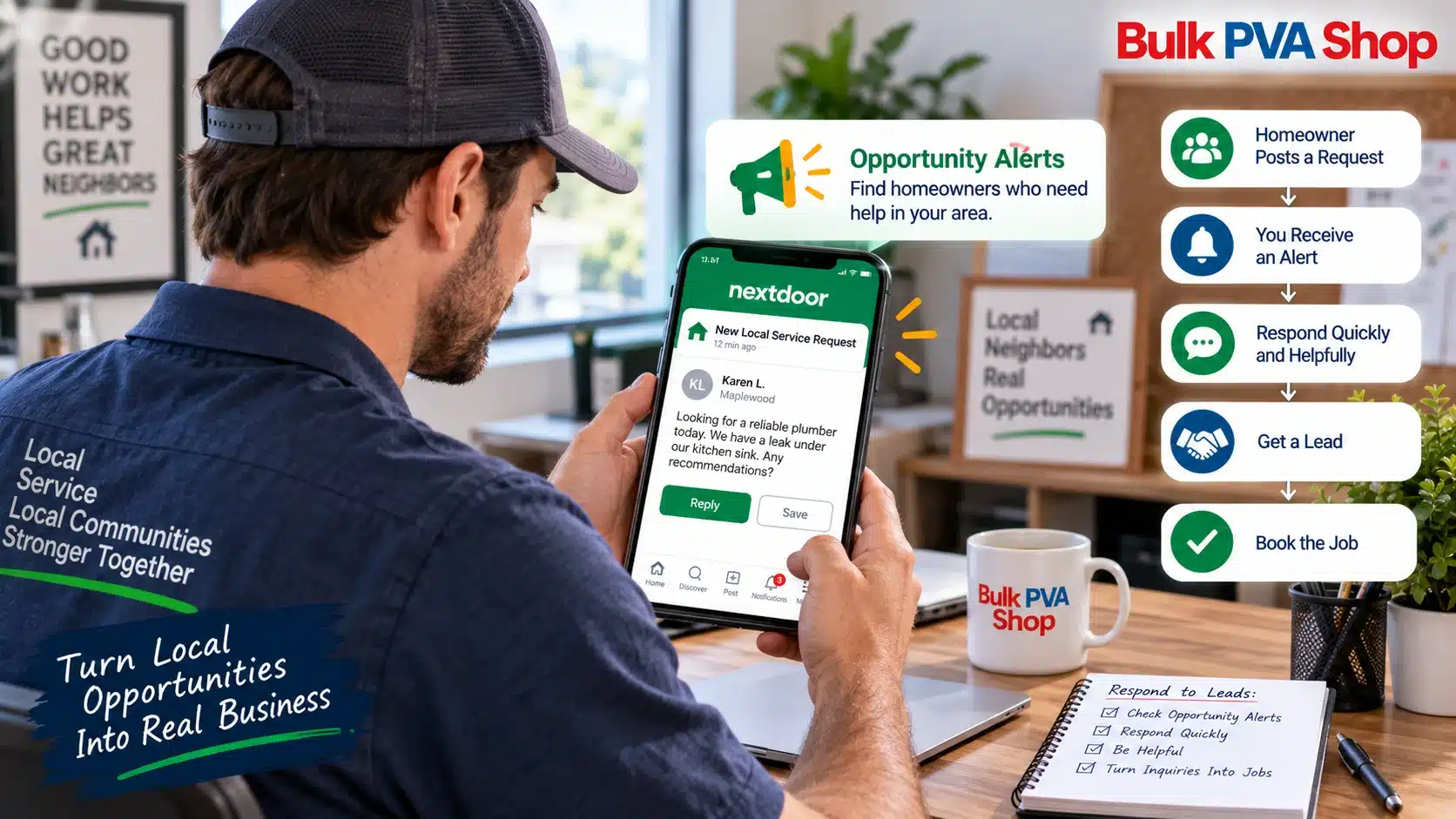
Nextdoor currently describes Opportunity Alerts as a way for eligible businesses to receive real-time notifications when neighbors post that they are looking for local professionals. Businesses can then respond to the request.
This is particularly relevant to service categories such as:
- Plumbing
- HVAC
- Roofing
- Electrical
- Landscaping
- Lawn care
- House cleaning
- Painting
- Handyman services
- Pest control
- Flooring
- Fencing
- Pressure washing
- Tree services
- General contracting
Availability depends on category and current Nextdoor eligibility.
Why Opportunity Alerts can be valuable
Traditional content marketing often works like:
Post → visibility → awareness → future customer
Opportunity Alerts can work more like:
Homeowner needs help → alert → business responds → potential lead
That’s a much shorter path to a sales conversation.
And speed matters.
If three local contractors receive the same opportunity, the business that responds quickly and professionally may have an advantage.
7. Give Homeowners a Clear Reason to Contact You
A common problem with local marketing is that businesses create awareness but don’t provide a clear next step.
Your content might say:
“Your water heater could be approaching the end of its useful life.”
That’s useful.
But you can make the conversion path clearer:
“If you’re noticing leaking, unusual noises, inconsistent hot water, or rusty water, our team can help identify the issue. Message our Business Page to schedule an inspection.”
The CTA should match the situation.
Examples
Plumber:
“Message us for a plumbing inspection.”
HVAC:
“Request an AC service appointment.”
Roofer:
“Schedule a roof inspection.”
Electrician:
“Contact us to discuss the electrical issue.”
Landscaper:
“Ask about availability in your neighborhood.”
Cleaner:
“Request a cleaning estimate.”
Avoid using a generic CTA on every post.
Make the next step specific.
8. Turn Before-and-After Projects Into Lead-Generating Content
Home service businesses have something many other businesses don’t:
visible results.
Use them.
A before-and-after project can demonstrate expertise without making exaggerated claims.
For example:
Before
“This backyard had drainage issues and an overgrown lawn.”
After
“We corrected the drainage problem, cleaned up the lawn, and redesigned the planting areas for easier maintenance.”
Then add a simple local CTA:
“We serve homeowners throughout [service area]. Message our Business Page if you’re considering a similar project.”
This type of content combines:
Proof + expertise + visual evidence + local relevance + CTA
That’s a strong lead-generation combination.
9. Use Seasonal Demand to Create Timely Leads
Home service demand changes throughout the year.
Use that to your advantage.
Spring
- Landscaping
- Lawn care
- Roof inspections
- Gutter cleaning
- Exterior painting
- HVAC preparation
Summer
- AC repair
- Lawn maintenance
- Pool services
- Pest control
- Exterior projects
- Emergency plumbing
Fall
- Furnace maintenance
- Gutter cleaning
- Roof inspections
- Tree trimming
- Weatherproofing
Winter
- Heating repairs
- Frozen pipe prevention
- Emergency plumbing
- Indoor remodeling
- Electrical issues
Instead of creating generic content all year, match your Nextdoor content to problems homeowners are likely thinking about now.
This can make your posts more relevant and your CTAs more timely.
10. Track Leads Instead of Likes
A post getting 100 reactions is not necessarily more valuable than a post that generates two profitable jobs.
Your goal is revenue.
Track metrics such as:
- Business Page views
- Faves
- Recommendations
- Post engagement
- Website visits
- Phone calls
- Messages
- Quote requests
- Appointments
- Leads
- Jobs won
- Revenue
- Cost per lead
- Cost per booked job
- Customer acquisition cost
A simple customer acquisition calculation is:
Customer Acquisition Cost = Total Nextdoor Marketing Cost ÷ New Customers Acquired
For example:
If you spend $600 on Nextdoor marketing and acquire six customers:
$600 ÷ 6 = $100 customer acquisition cost
Then compare that $100 against the profit and long-term value of those customers.
A Simple Nextdoor Lead Generation Funnel
A strong Nextdoor strategy can be organized into six stages.
Stage 1: Awareness
A homeowner sees your business.
Stage 2: Familiarity
They repeatedly encounter your content, Business Page, or local presence.
Stage 3: Trust
They see Faves, recommendations, photos, helpful information, and evidence of real work.
Stage 4: Intent
They experience a home problem or actively begin looking for a provider.
Stage 5: Lead
They call, message, request information, or visit your website.
Stage 6: Customer
They schedule and pay for the service.
Then the process starts again:
Great customer experience → recommendation/Fave → more trust → more leads
That’s why Nextdoor should be treated as more than a posting platform.
It’s a local reputation and customer-acquisition system.
What Should a Home Service Business Post on Nextdoor?
Here’s a simple content framework you can use.
| Content Type | Example |
| Educational | “5 signs your AC needs attention” |
| Problem/Solution | “Why your water pressure suddenly dropped” |
| Before & After | “Backyard drainage project: before and after” |
| Seasonal | “Fall roof checklist for local homeowners” |
| FAQ | “How often should you have your gutters cleaned?” |
| Local | “Common lawn problems we’re seeing this month” |
| Customer Story | “How we helped a homeowner fix a recurring leak” |
| Behind the Scenes | “What our technicians check during an AC tune-up” |
| Offer | “Spring HVAC maintenance appointments now available” |
| Community | “Proud to serve homeowners throughout [area]” |
A useful content mix is:
Education + Proof + Local relevance + Occasional promotion
rather than:
Promotion + Promotion + Promotion + Promotion
How to Get More Nextdoor Leads for Different Home Services
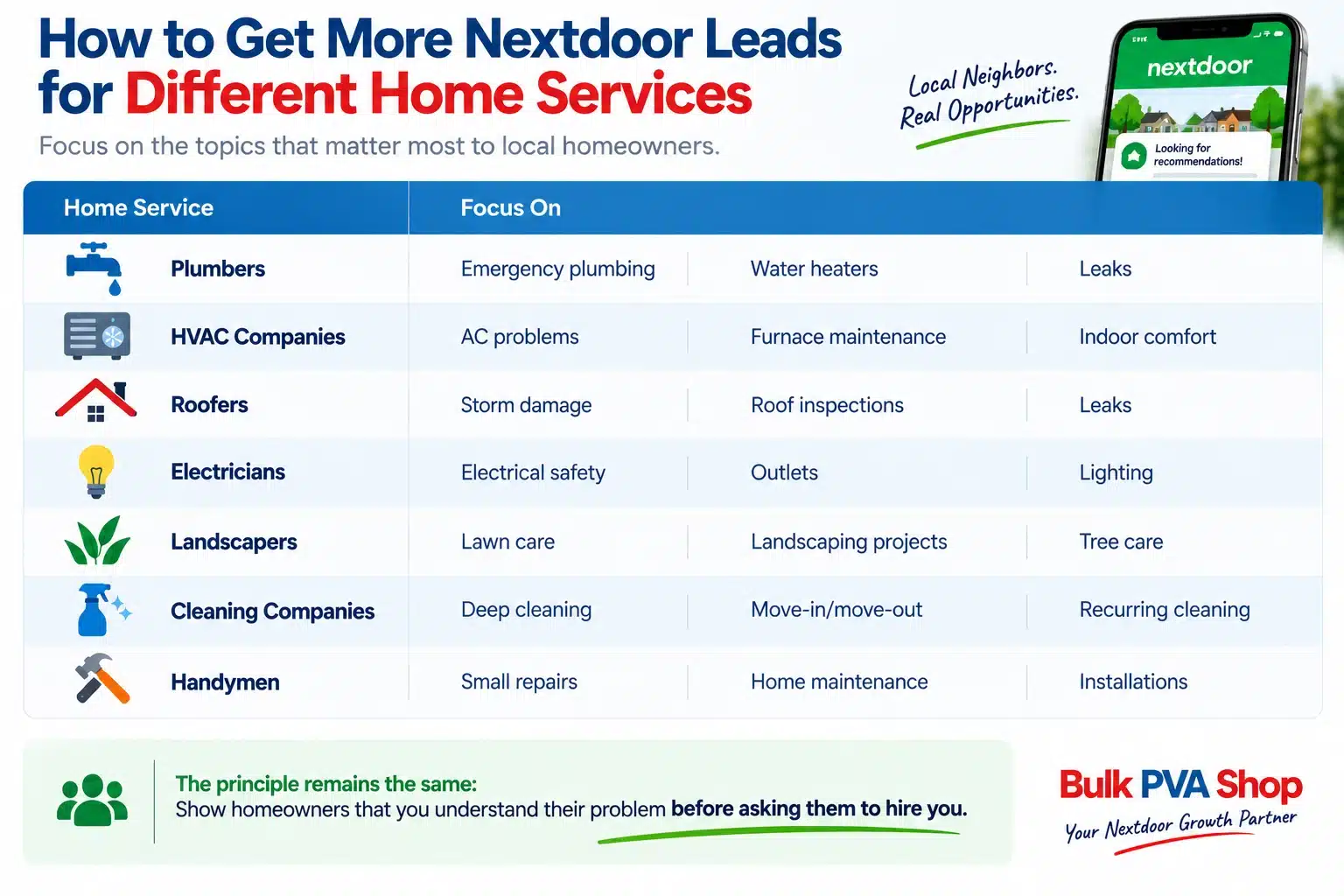
Plumbers
Focus on:
- Emergency plumbing
- Water heaters
- Drain problems
- Leaks
- Water pressure
- Pipe maintenance
- Local homeowner questions
HVAC Companies
Focus on:
- AC problems
- Furnace maintenance
- Indoor comfort
- Energy efficiency
- Seasonal preparation
- Repair vs. replacement
Roofers
Focus on:
- Storm damage
- Roof inspections
- Leaks
- Missing shingles
- Maintenance
- Before-and-after projects
Electricians
Focus on:
- Electrical safety
- Outlets
- Lighting
- Panels
- Warning signs
- Home electrical upgrades
Landscapers
Focus on:
- Lawn care
- Seasonal maintenance
- Landscaping projects
- Tree care
- Yard transformations
- Local growing conditions
Cleaning Companies
Focus on:
- Deep cleaning
- Move-in/move-out cleaning
- Recurring cleaning
- Seasonal cleaning
- Before-and-after results
- Home organization
Handymen
Focus on:
- Small repairs
- Home maintenance
- Seasonal projects
- Installation work
- Repair vs. replacement
- Before-and-after projects
The principle remains the same:
Show homeowners that you understand their problem before asking them to hire you.
Why Your Nextdoor Leads May Be Low
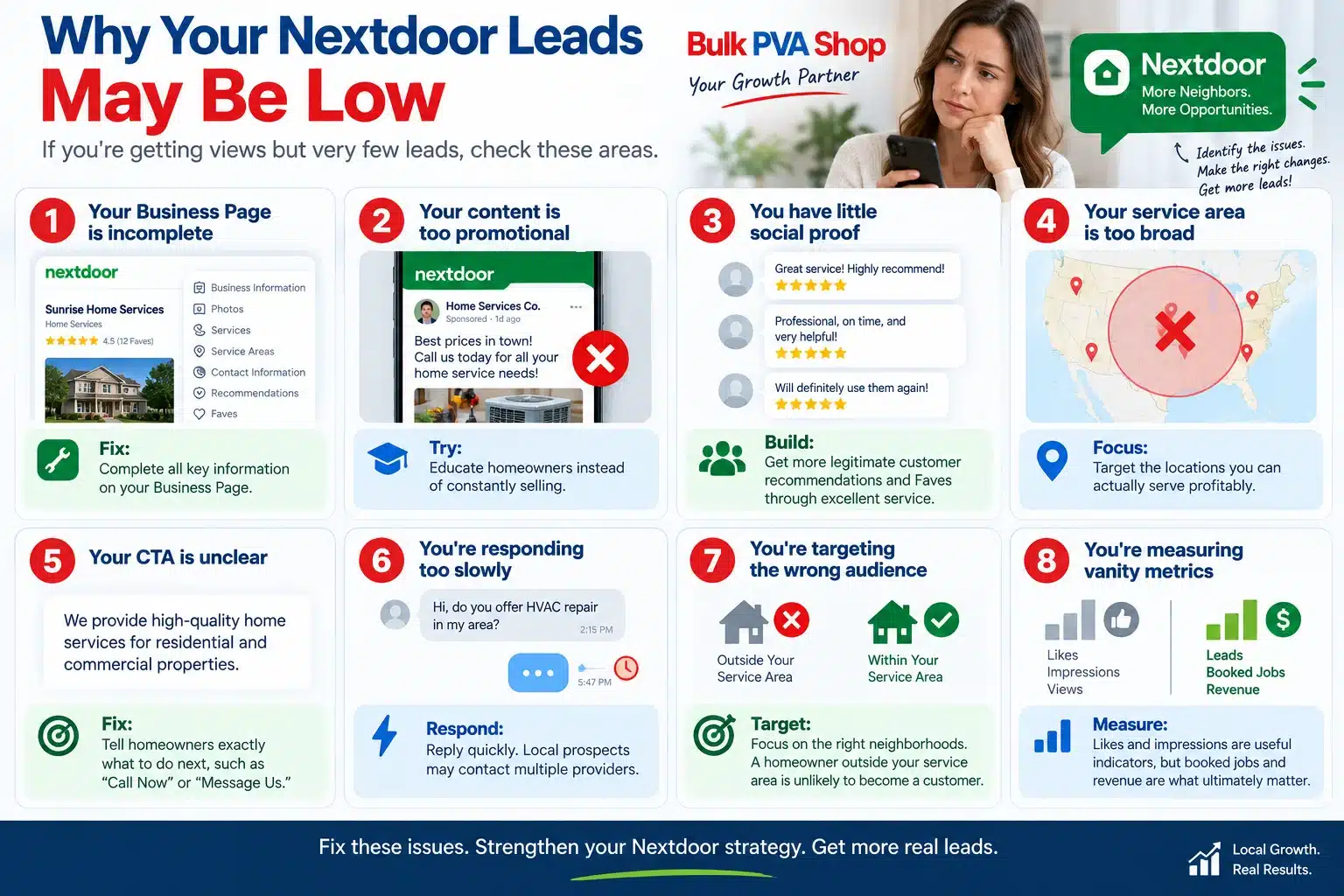
If you’re getting views but very few leads, check these areas.
Your Business Page is incomplete
Fix:
- Business information
- Photos
- Services
- Service areas
- Contact information
- Recommendations
- Faves
Your content is too promotional
Try educating homeowners instead of constantly selling.
You have little social proof
Build legitimate customer recommendations and Faves through excellent service and appropriate follow-up.
Your service area is too broad
Focus on the locations you can actually serve profitably.
Your CTA is unclear
Tell homeowners exactly what to do next.
You’re responding too slowly
Local prospects may contact multiple providers.
You’re targeting the wrong audience
A homeowner outside your service area is unlikely to become a profitable customer.
You’re measuring vanity metrics
Likes and impressions are useful indicators, but booked jobs and revenue are what ultimately matter.
Nextdoor Leads vs. Google Leads
Nextdoor and Google can play different roles.
Someone searching Google for:
“Emergency plumber near me”
already has strong intent.
Someone asking Nextdoor:
“Who do you recommend for a plumber?”
is also showing intent, but through a recommendation-driven local environment.
A good home service marketing system can use both.
Google: Capture existing search demand.
Nextdoor: Build local visibility, trust, recommendations, and discovery.
Website: Provide information and convert interested prospects.
Customer reviews/Faves: Reduce perceived risk.
CRM/SMS/email: Follow up and retain customers.
Don’t force yourself to choose only one lead source.
Build a system where the channels support each other.
How to Get More Nextdoor Leads Without Spending More Money
You don’t necessarily need a large advertising budget to improve your results.
Start by improving the assets you already have.
First, improve your Business Page.
Make it complete and trustworthy.
Second, improve your reputation.
Ask satisfied customers for legitimate Faves and recommendations.
Third, improve your content.
Answer real homeowner questions.
Fourth, improve your local targeting.
Talk about the communities you actually serve.
Fifth, improve response time.
Make it easy for interested homeowners to contact you.
Sixth, improve your follow-up.
A lead that doesn’t immediately book may still become a customer later.
This is often a better starting point than simply increasing ad spend.
Should You Use Nextdoor Ads?
Paid advertising can make sense once your organic foundation is strong.
Nextdoor currently offers advertising products alongside free Business Pages and Business Posts.
But don’t begin with:
“How much should I spend?”
Start with:
“What customer action am I trying to generate?”
For example:
- More calls
- More website visits
- More estimate requests
- More appointments
- More awareness in a new service area
- More seasonal bookings
Then measure the campaign against that objective.
If your Business Page is weak and your offer is unclear, increasing advertising spend may simply send more people to a weak conversion point.
A 30-Day Plan to Get More Leads From Nextdoor
Week 1: Fix your foundation
- Claim or verify your Business Page
- Complete your profile
- Add services
- Add service areas
- Add professional photos
- Add contact information
- Review your existing recommendations
- Make sure your CTA is clear
Week 2: Start publishing useful content
Create posts around:
- Homeowner problems
- Seasonal maintenance
- FAQs
- Before-and-after projects
- Common mistakes
- Local issues
Aim for useful content rather than constant promotion.
Week 3: Build social proof
- Follow up with happy customers
- Ask appropriately for Faves/recommendations
- Share successful projects
- Add better photos
- Identify your strongest services
- Improve your Business Page based on customer questions
Week 4: Focus on conversion
- Monitor homeowner requests
- Respond quickly
- Test a relevant offer
- Explore Opportunity Alerts if eligible
- Test paid advertising if appropriate
- Track calls and leads
- Measure booked jobs
At the end of the month, ask:
How many real opportunities came from Nextdoor?
Then ask:
How many became customers?
That’s the number that matters.
7 Nextdoor Lead Generation Mistakes to Avoid
1. Using a personal account to advertise your business
Nextdoor’s current policy directs business promotion to Business Pages rather than personal neighbor accounts.
2. Posting only advertisements
Useful content builds more trust than endless sales pitches.
3. Ignoring Faves
Your reputation can influence whether a homeowner chooses you.
4. Targeting locations you don’t serve
Local marketing only works when your service area makes operational sense.
5. Responding slowly
Speed can matter when homeowners are contacting multiple providers.
6. Buying traffic before fixing your conversion system
A strong Business Page should come before aggressive promotion.
7. Measuring likes instead of revenue
Track leads, estimates, jobs, and customer acquisition cost.
How Nextdoor Fits Into a Larger Local Marketing Strategy
Nextdoor shouldn’t necessarily replace your other marketing channels.
Instead, think of it as one part of your local acquisition system.
For a home service company, your ecosystem might look like:
Google → captures search demand
Nextdoor → builds local discovery and trust
Website → converts interested prospects
Reviews/Faves → strengthen credibility
Email/SMS → follow up
Referrals → create additional customers
Paid advertising → accelerate selected campaigns
This diversified approach is generally stronger than depending entirely on one platform.
Internal Resources to Continue Learning
If you’re new to Nextdoor, start with our guide on what Nextdoor is and how the platform works.
For the business side, read our guide to how Nextdoor works for businesses.
If you’re building a broader local marketing system, our Nextdoor marketing strategy for small businesses guide covers the bigger picture.
You can also learn how to get more recommendations on Nextdoor, which is particularly relevant for home service businesses.
For a broader platform comparison, see Nextdoor vs. Facebook for local marketing.
And if you want a broader home-services strategy, continue with our complete guide to Nextdoor marketing for home service businesses.
Frequently Asked Questions
How do I get more leads from Nextdoor?
Start with a complete Business Page, build legitimate Faves and recommendations, publish useful local content, respond quickly to homeowner inquiries, and use relevant Nextdoor business tools such as Business Posts and Opportunity Alerts. Track actual leads and booked jobs rather than relying only on engagement metrics.
Is Nextdoor good for home service businesses?
It can be especially useful for businesses that depend on local homeowners, geographic proximity, reputation, and recommendations. Results vary by market and service category, so Nextdoor should be evaluated alongside other lead sources.
How do contractors get customers from Nextdoor?
Contractors can attract customers by maintaining a strong Business Page, publishing helpful homeowner content, building Faves and recommendations, responding to relevant requests, and using available lead-generation and advertising tools.
What should a home service business post on Nextdoor?
Good topics include homeowner FAQs, maintenance tips, seasonal advice, before-and-after projects, common problems, local service information, customer stories, and occasional offers.
How do I get more Faves on Nextdoor?
Provide excellent service and appropriately ask satisfied customers to Fave your business. Nextdoor currently provides businesses with a Fave link that can be shared with customers.
Are Nextdoor Opportunity Alerts worth it?
They can be useful for eligible home service businesses because they can notify businesses when local homeowners are looking for specific services. Evaluate the cost against the number and quality of opportunities and the number of jobs you actually win.
Should I advertise my home service business from my personal Nextdoor account?
No. Under Nextdoor’s current 2026 policy, commercial promotion should be done through a Business Page rather than using a personal neighbor account as a business advertising channel.
How often should I post on Nextdoor?
There is no universal posting frequency that guarantees leads. Focus on consistency and usefulness rather than posting simply to hit a number. Your content should answer real homeowner questions and remain relevant to your service area.
Can Nextdoor replace Google for home service leads?
Usually, it is better to treat them as complementary channels. Google can capture homeowners who are actively searching for a service, while Nextdoor can help with local discovery, recommendations, reputation, and neighborhood awareness.
Final Takeaway: Turn Nextdoor Visibility Into a Lead System
Getting more leads from Nextdoor isn’t about posting more advertisements.
It’s about building a local system that makes homeowners comfortable choosing your business.
The formula is straightforward:
Complete Business Page
↓
Useful local content
↓
Faves and recommendations
↓
Local visibility
↓
Fast response to homeowner intent
↓
Lead
↓
Booked job
↓
Happy customer
↓
More recommendations
The businesses that approach Nextdoor this way aren’t simply trying to get attention.
They’re building a local reputation engine that can generate leads over time.
Start with the foundation, stay genuinely useful, respond quickly, measure real business results, and use paid tools only when they support a clear acquisition goal.
For a home service business, that combination can turn Nextdoor from another social platform into a meaningful part of your local lead-generation strategy.