If you are trying to reach customers in a specific local area, both Nextdoor and Facebook can help — but they work in completely different ways, and they are not interchangeable.
The short answer: Nextdoor wins for hyperlocal trust and neighbourhood-level targeting. Facebook wins for audience size, paid advertising options, and content versatility. For most local businesses, the best strategy is to use both — but understanding what each platform does well is what stops you from wasting time on the wrong one.
This guide gives you an honest, side-by-side comparison of both platforms so you can decide where to focus your time and budget.
The Fundamental Difference Between the Two Platforms
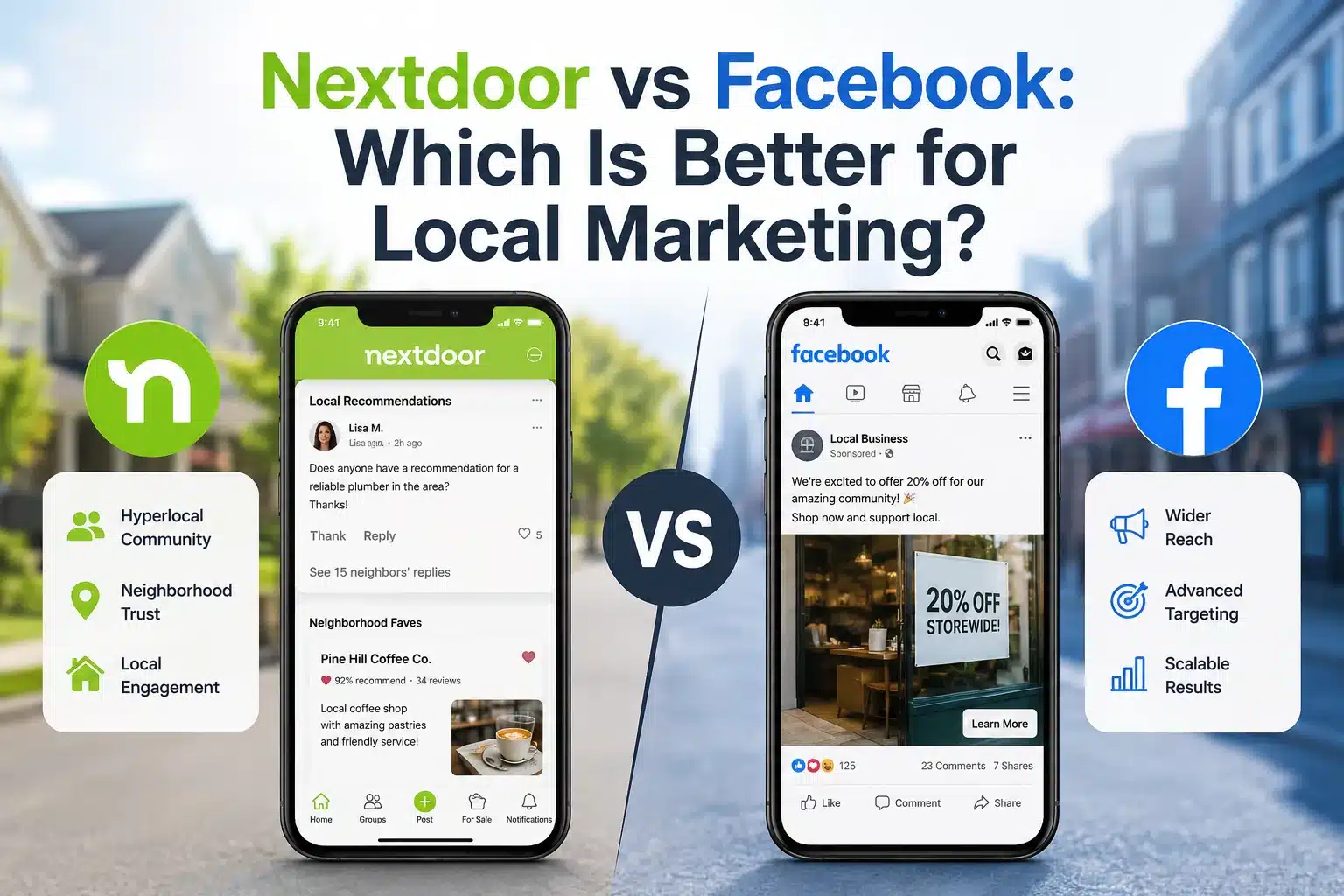
Before comparing features, it helps to understand what makes these two platforms fundamentally different from each other.
Facebook — owned by Meta — is a general social network with over three billion active users worldwide according to Meta’s most recently reported figures. It connects people based on shared interests, relationships, and online behaviour. Facebook Groups allow communities to form around any topic — hobbies, local areas, businesses, causes — but membership is not restricted to any physical location. Anyone anywhere can join a local Facebook Group, and there is no verification that members actually live in the area.
Nextdoor — a standalone platform founded in 2011 — is built entirely around verified home addresses. According to Nextdoor’s own published figures, the platform now has over 80 million verified neighbours across more than 11 countries. Every member must confirm where they live before they can participate. There are no interest-based groups, no global feeds, and no anonymous users. Everything on Nextdoor happens within the context of a specific, verified neighbourhood.
This single difference — verified location vs open membership — shapes every aspect of how the two platforms work for local businesses.
Nextdoor vs Facebook — Head-to-Head Comparison
| Factor | Nextdoor | Facebook Groups |
| User base | 80M+ verified neighbours | 3B+ global users |
| Geographic targeting | Neighbourhood-level (verified) | City, interest, or self-selected |
| Member verification | Address-verified residents | No verification required |
| Trust level | Very high — real neighbours | Variable — anonymous members |
| Organic reach | Strong for local content | Declining — algorithm restricts |
| Paid advertising | Local Deals + Sponsorships | Full Meta Ads platform |
| Business profiles | Free Business Page | Free Page + Groups |
| Recommendations | Neighbour recommendations | Reviews + Group mentions |
| Content types | Text posts, events, deals | Posts, video, stories, reels |
| Best for | Hyperlocal trust + recommendations | Broad reach + paid campaigns |
| Monthly cost (free tier) | Free | Free |
| Audience quality (local) | Exceptionally high | Moderate — mixed |
Where Nextdoor Wins
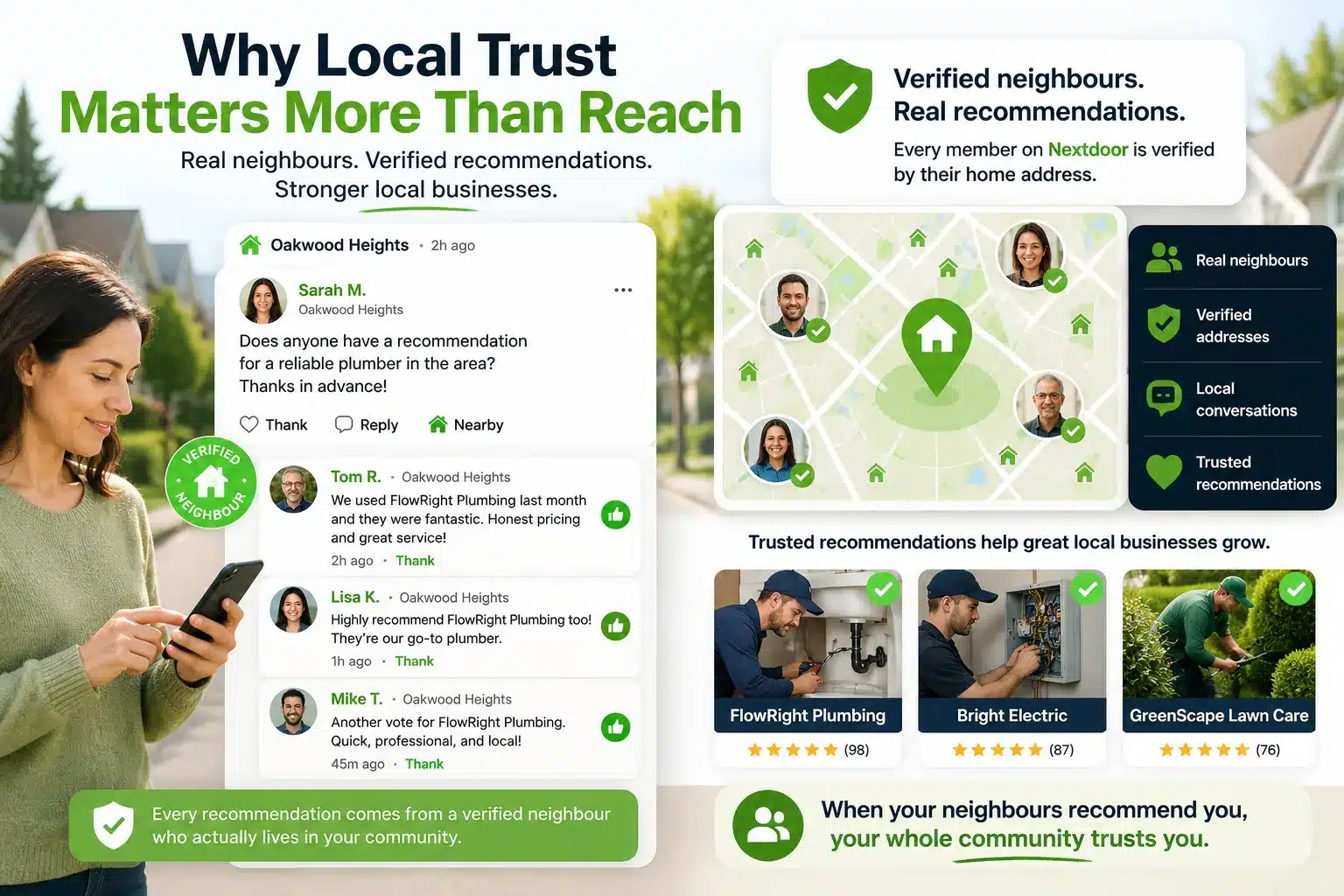
1. Trust — there is no comparison
The most important advantage Nextdoor has over Facebook is trust. When a verified neighbour recommends a plumber on Nextdoor, every person who reads that recommendation knows it came from someone who actually lives nearby. They are not reading a review from a stranger on the other side of the world. They are reading a recommendation from someone on their street.
Facebook reviews and Group mentions can come from anywhere. They can be posted by people with no connection to the neighbourhood, fake accounts, or competitors. On Nextdoor, every single interaction is tied to a verified home address. For local businesses that rely on word-of-mouth, this trust differential is enormous.
2. Neighbourhood-level targeting
Facebook’s geographic targeting goes down to city or postcode level for organic content. Nextdoor goes down to individual neighbourhood level — and does it automatically. Every post you make as a local business is shown to verified residents in your immediate area without any setup, audience-building, or targeting configuration.
For a business that only serves a specific neighbourhood or small cluster of streets, this precision is simply not achievable through any other free channel.
3. Recommendations carry real weight
Nextdoor’s recommendation system is one of the most powerful trust-building tools available to any local business. A recommendation is a public statement from a verified neighbour that they used your service and would tell their community to use it too. New residents looking for local services check these recommendations the way people used to ask a neighbour over the fence.
Businesses with strong Nextdoor recommendations consistently outperform competitors in local search results on the platform — regardless of how much those competitors spend on advertising.
4. Less competition — for now
Compared to Facebook, Nextdoor is significantly less crowded with business content. Most local businesses are still not active on Nextdoor, which means the businesses that are active stand out much more than they would on a platform where every competitor is already posting. This early-mover advantage is real — and it will not last indefinitely.
Where Facebook Wins
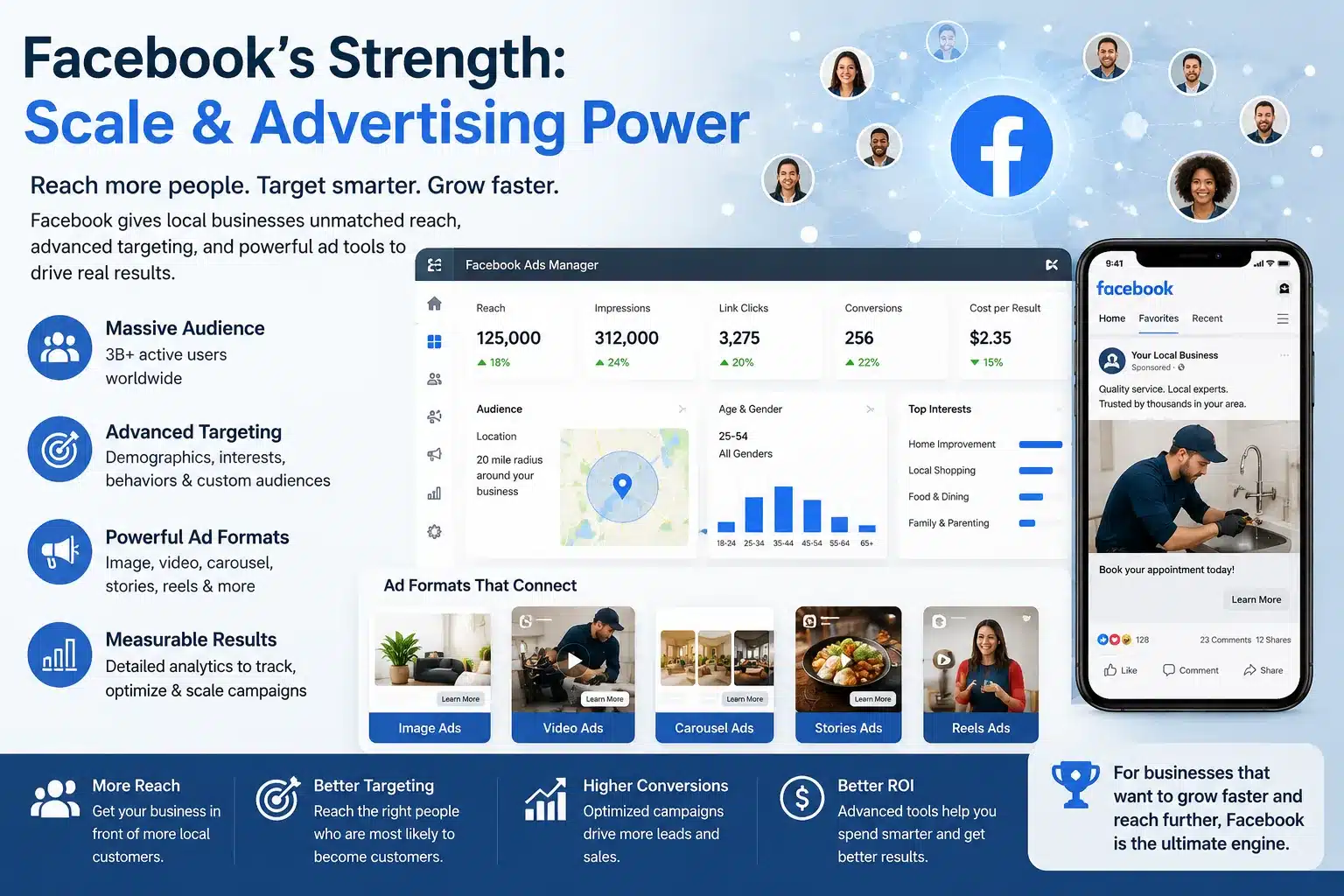
1. Audience size and reach
Facebook has over three billion active users. Even a local Facebook Group for a medium-sized town can have tens of thousands of members. Nextdoor’s audience in any given neighbourhood is limited to the people who live there — which might be a few hundred to a few thousand households.
If your goal is to reach as many people as possible — even at the cost of some targeting precision — Facebook wins on raw numbers every time.
2. Paid advertising power
Meta Ads is one of the most sophisticated advertising platforms ever built. Facebook’s paid options include detailed demographic targeting, custom audiences, lookalike audiences, retargeting, video ads, carousel ads, and a full analytics suite. Local businesses that want to run paid campaigns have far more flexibility, control, and measurability on Facebook than Nextdoor’s simpler Local Deals and Neighbourhood Sponsorship products.
For businesses with an advertising budget and the skills to use Meta Ads well, Facebook is a significantly more powerful paid channel than Nextdoor.
3. Content variety
Facebook supports a much wider range of content formats — text posts, photos, videos, Reels, Stories, events, live streams, and links. This gives businesses more creative options for engaging their audience and building a brand presence. Nextdoor is primarily a text and image platform — it is functional and trusted, but it does not have the same content ecosystem as Facebook.
4. Groups for community building
Facebook Groups allow businesses to create and moderate their own community spaces — something Nextdoor does not offer in the same way. A local business that wants to build an owned community of loyal customers, run exclusive promotions, or create a membership-style experience is better served by a Facebook Group than anything Nextdoor currently offers.
5. Broader demographics
Nextdoor’s user base skews toward homeowners and longer-term residents. Facebook’s user base, while not universal, covers a broader demographic range including younger audiences, renters, and short-term residents who may not be active on Nextdoor. Depending on your target customer, Facebook may reach people Nextdoor simply does not.
Which Platform Is Better for Each Business Type?
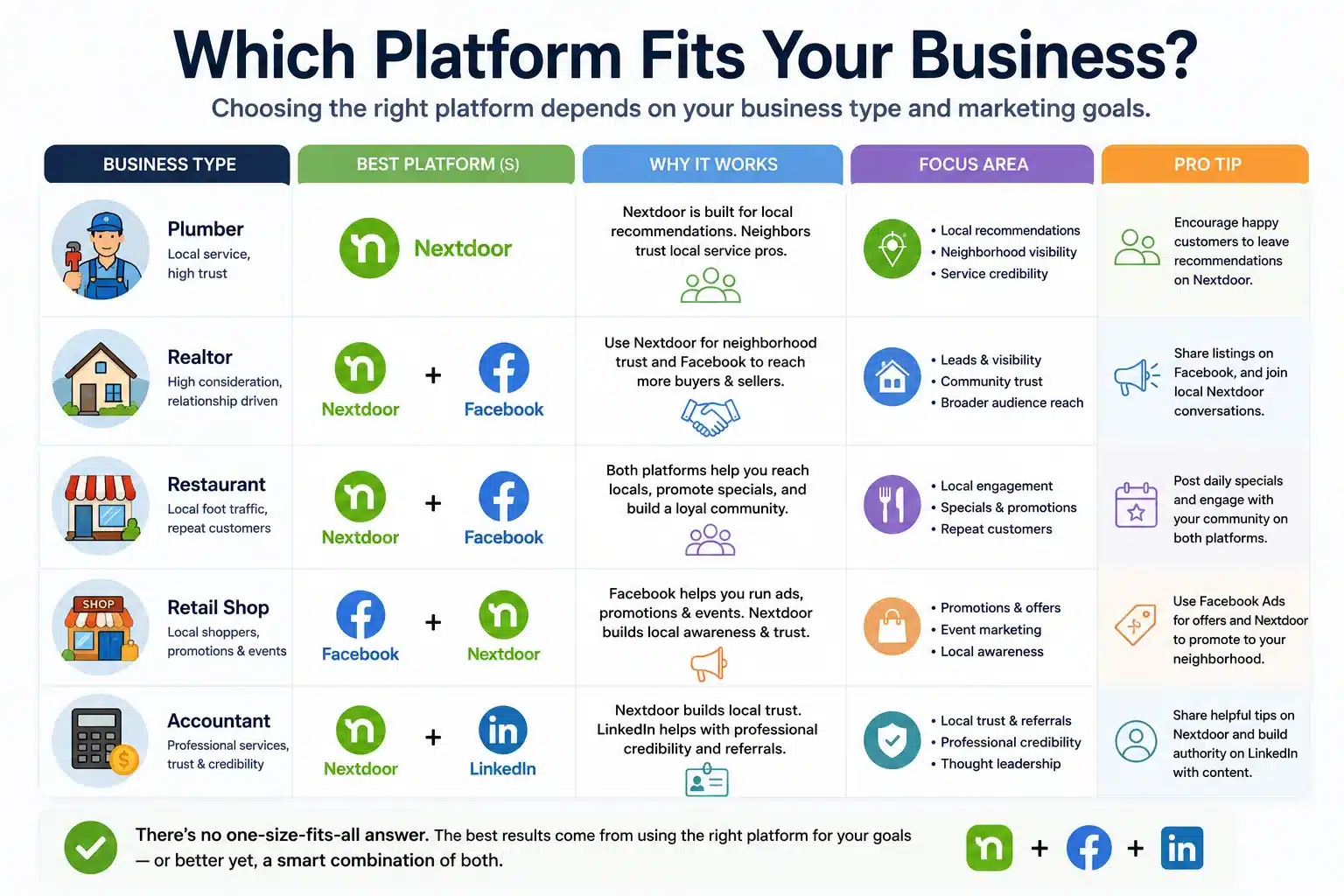
The honest answer is that it depends on your business type and your goals. Here is a practical guide:
Home services (plumbers, electricians, cleaners, landscapers) → Nextdoor first
Home services are the single strongest category on Nextdoor. Residents specifically ask their neighbours for recommendations for tradespeople — “Does anyone know a reliable plumber?” is one of the most common questions on the platform. The trust model is perfectly suited to this category. Start with Nextdoor, build recommendations, then use Facebook for broader reach.
Real estate agents → Both, but Nextdoor for organic trust
Real estate is one of Nextdoor’s strongest categories. Residents are naturally interested in local property activity and agents who build a genuine community presence on Nextdoor generate referrals that are difficult to replicate on Facebook. That said, Facebook Ads are powerful for property promotion and should run alongside your Nextdoor organic strategy.
Restaurants and food businesses → Both equally
Local dining is one of the most recommended categories on both platforms. Nextdoor recommendations from neighbours carry enormous trust for restaurants. Facebook events and promotions reach a broader local audience including visitors and people outside the immediate neighbourhood. Run both simultaneously for best results.
Retail and independent shops → Facebook for awareness, Nextdoor for trust
Use Facebook to drive awareness, promote events, and run paid campaigns. Use Nextdoor to build community reputation and collect neighbourhood recommendations. The combination works well for independent retailers competing against larger chains.
Professional services (accountants, solicitors, consultants) → Nextdoor for local, LinkedIn for professional
Nextdoor works well for professional services that serve a specific local area. However, LinkedIn is generally a stronger platform for professional services than either Nextdoor or Facebook for most B2B-focused businesses. Use Nextdoor for local reputation, LinkedIn for professional credibility.
Marketing agencies managing multiple local clients → Both, managed at scale
Agencies running local campaigns for multiple clients need both platforms — and need to manage multiple local presences simultaneously. On Nextdoor specifically, one account covers one neighbourhood. Agencies managing campaigns across multiple areas typically use verified Nextdoor accounts to cover each client’s target neighbourhood.
→ Buy Verified Nextdoor Accounts
The Organic Reach Problem — Why It Matters
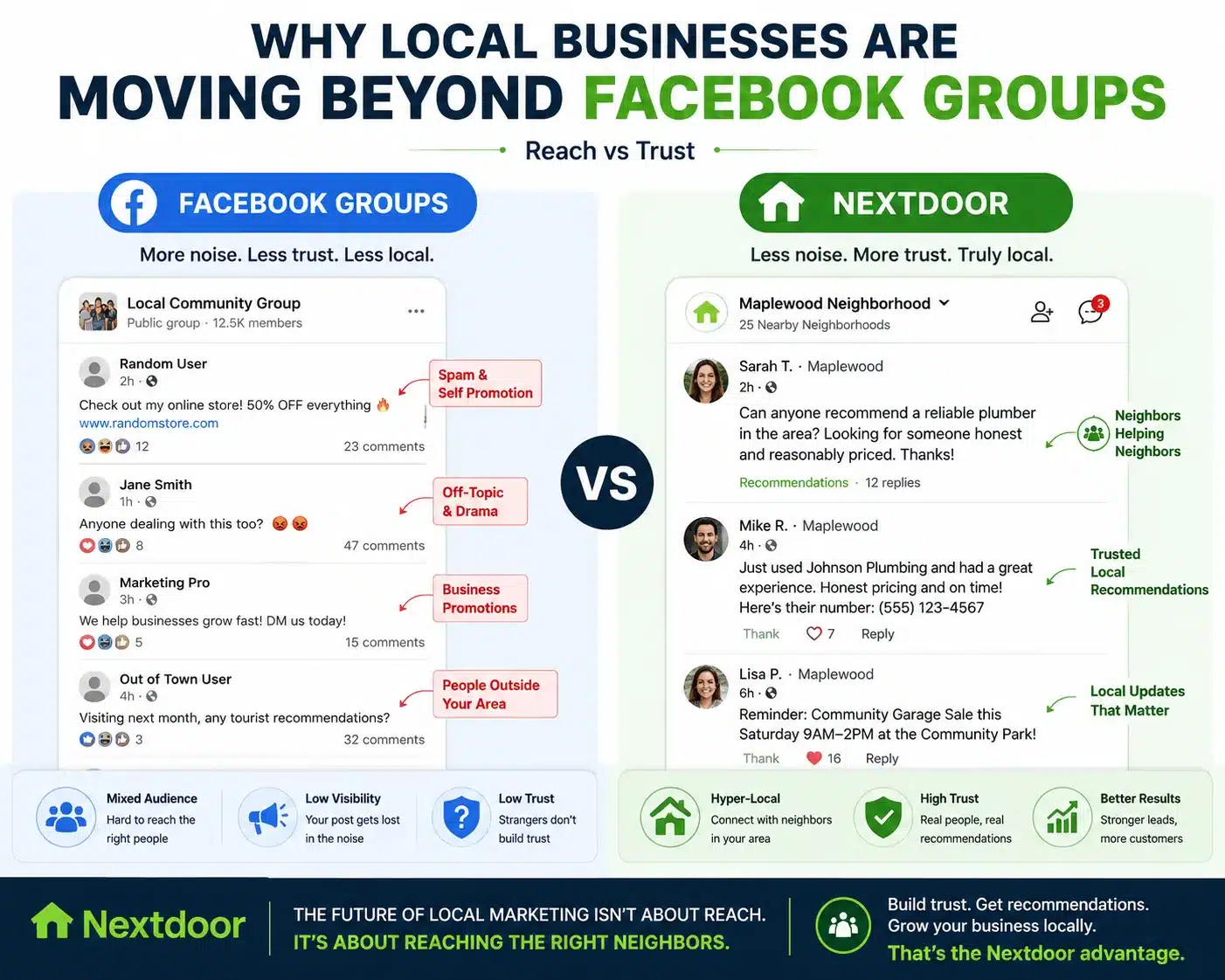
One of the most significant practical differences between the two platforms is what has happened to organic reach.
Facebook’s algorithm has progressively reduced the organic reach of business content over the past decade. A Facebook Page with 10,000 followers might only reach 300 to 500 of them with an unpaid post. Business content competes against personal content, viral content, advertising, and algorithmically preferred posts from accounts with high engagement history. For most small businesses, Facebook organic reach alone is not enough — paid promotion is increasingly necessary to be seen.
Nextdoor’s algorithm is different. Because the platform is geographically bounded and there is far less content competing for resident attention, organic business posts get meaningful reach without payment. A new restaurant posting about its weekly special will be seen by a significant portion of local residents — not because it paid for placement, but because the local content is genuinely relevant to the feed.
This makes Nextdoor a more efficient platform for businesses with limited marketing budgets. You can build a meaningful local presence on Nextdoor for free in a way that has become very difficult on Facebook without paid support.
Can You Use Both Platforms Together?
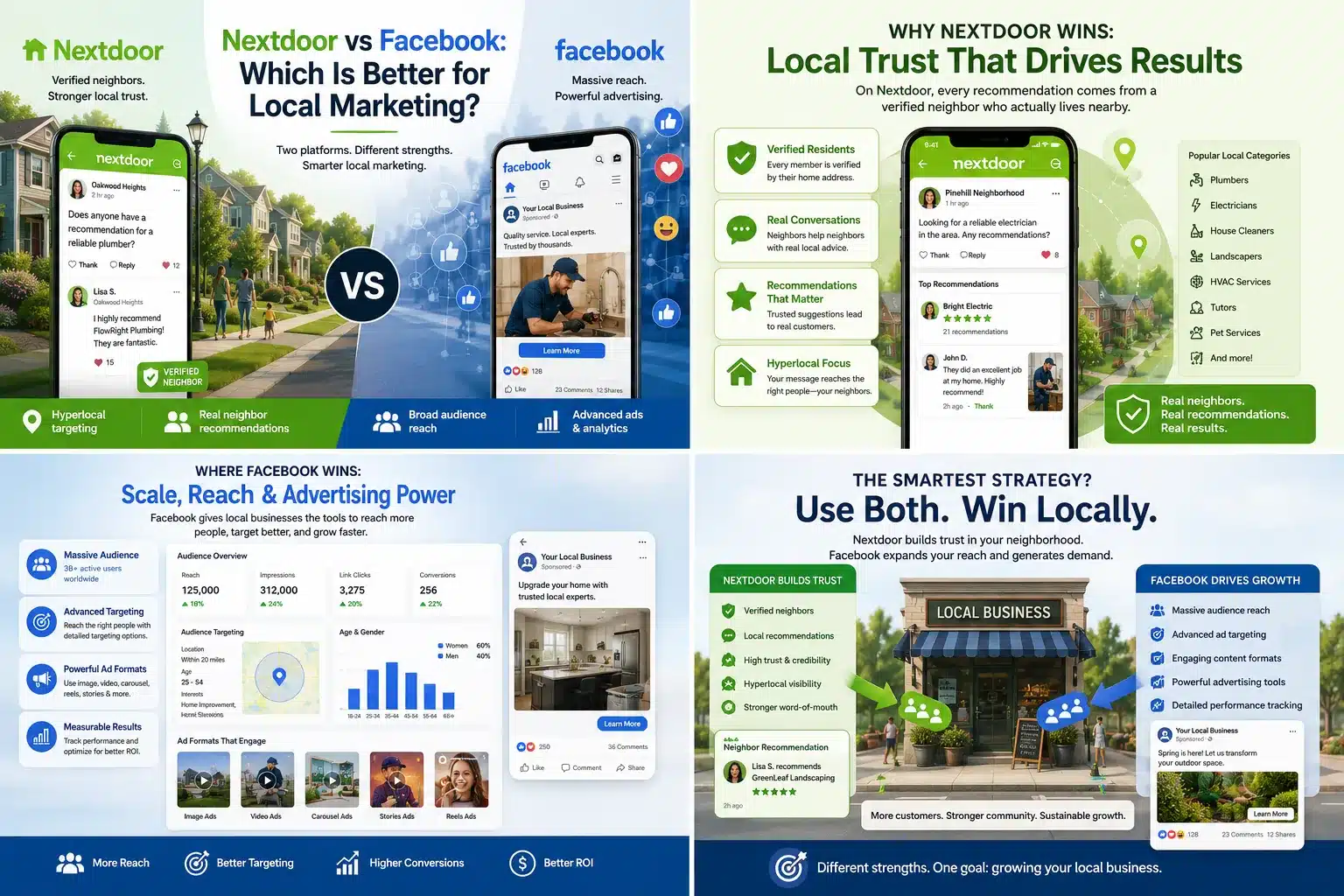
The most effective approach for most local businesses is not to choose between the two — it is to use them together with a clear understanding of what each does best.
Here is a simple way to think about it:
Use Nextdoor for:
- Building neighbourhood trust and reputation
- Earning and showcasing recommendations
- Reaching verified, nearby residents organically
- Hyperlocal promotions and community engagement
Use Facebook for:
- Reaching a broader local audience including non-residents
- Running paid advertising campaigns
- Video content, Reels, and richer media formats
- Building an owned community through a Facebook Group
- Event promotion and ticket sales
The two platforms complement each other well. A strong Nextdoor presence builds the trust that makes Facebook advertising more effective — people who have already heard of your business through Nextdoor are more likely to respond to your Facebook ads.
FAQ SECTION
Q: Is Nextdoor better than Facebook for local marketing?
A: For hyperlocal, neighbourhood-level marketing, Nextdoor is generally better than Facebook because every member is a verified local resident and organic business content gets meaningful reach without paid promotion. However, Facebook is better for broader local reach, paid advertising, and richer content formats. Most local businesses benefit from using both platforms together rather than choosing one.
Q: What is the main difference between Nextdoor and Facebook Groups?
A: The main difference is member verification. Every Nextdoor member must verify their home address before participating — so every interaction is with a confirmed local resident. Facebook Group members are unverified and can join from anywhere. This means Nextdoor recommendations and endorsements carry significantly more trust for local businesses than equivalent Facebook Group mentions.
Q: Does Nextdoor have better organic reach than Facebook?
A: Yes — for local business content, Nextdoor generally delivers better organic reach than Facebook. Facebook’s algorithm has progressively reduced organic reach for business pages over the years, making paid promotion increasingly necessary. On Nextdoor, locally relevant business posts reach a meaningful proportion of nearby verified residents without any paid support, making it more cost-effective for businesses with limited marketing budgets.
Q: Which platform is better for small local businesses with no ad budget?
A: For small local businesses with no advertising budget, Nextdoor is the stronger starting point. The free tools — a Business Page, organic posts, and the recommendations system — deliver genuine local reach without any cost. Building five or more recommendations on Nextdoor costs nothing and delivers a level of local trust that is very difficult to replicate on Facebook without paid advertising.
Q: Can I use Nextdoor and Facebook at the same time?
A: Yes — and for most local businesses this is the recommended approach. Use Nextdoor to build neighbourhood trust and earn recommendations from verified local residents. Use Facebook for broader local reach, paid advertising, and richer content formats like video and events. The two platforms complement each other well and serve different but overlapping audiences.
Q: Is Facebook or Nextdoor better for real estate?
A: Both platforms are strong for real estate, but they serve different purposes. Nextdoor builds the neighbourhood trust and community reputation that generates organic referrals — residents are naturally interested in local property activity and agents with a strong Nextdoor presence benefit significantly. Facebook Ads are better for direct property promotion and reaching buyers beyond the immediate neighbourhood. Using both together is the most effective approach.
Q: How does Nextdoor compare to Facebook for restaurants?
A: Restaurants perform well on both platforms. Nextdoor recommendations from local residents carry high trust and drive repeat visits from the surrounding neighbourhood. Facebook is better for event promotion, reaching visitors and non-residents, and running paid campaigns for broader local awareness. Most successful local restaurants use both — Nextdoor for neighbourhood reputation, Facebook for broader audience reach and promotions.
Q: Does Nextdoor have paid advertising like Facebook?
A: Nextdoor offers two paid promotion options — Local Deals (promotional posts that appear prominently in local feeds) and Neighbourhood Sponsorships (premium placement in a specific neighbourhood’s digest and search results). These are simpler and less flexible than Facebook’s full Meta Ads platform. For businesses that need sophisticated targeting, retargeting, or detailed campaign analytics, Facebook’s paid advertising is significantly more powerful than Nextdoor’s current paid options.
CONCLUSION
Nextdoor and Facebook are not really competing for the same thing — they are just often compared because both have a “local” dimension.
Nextdoor is unmatched for building genuine neighbourhood trust, earning verified local recommendations, and reaching nearby residents organically without paying for every impression. If your business serves a specific local area and relies on word-of-mouth, Nextdoor should be a core part of your strategy.
Facebook is unmatched for audience scale, paid advertising sophistication, and content versatility. If you need to reach people beyond your immediate neighbourhood or run proper paid campaigns, Facebook gives you tools that Nextdoor simply does not have yet.
Use both. Start with Nextdoor if you are new to local marketing and have a limited budget — the trust you build there is the foundation that makes everything else more effective.
Related reading: → Nextdoor for Local Marketing — Complete Guide → How Does Nextdoor Work for Businesses?